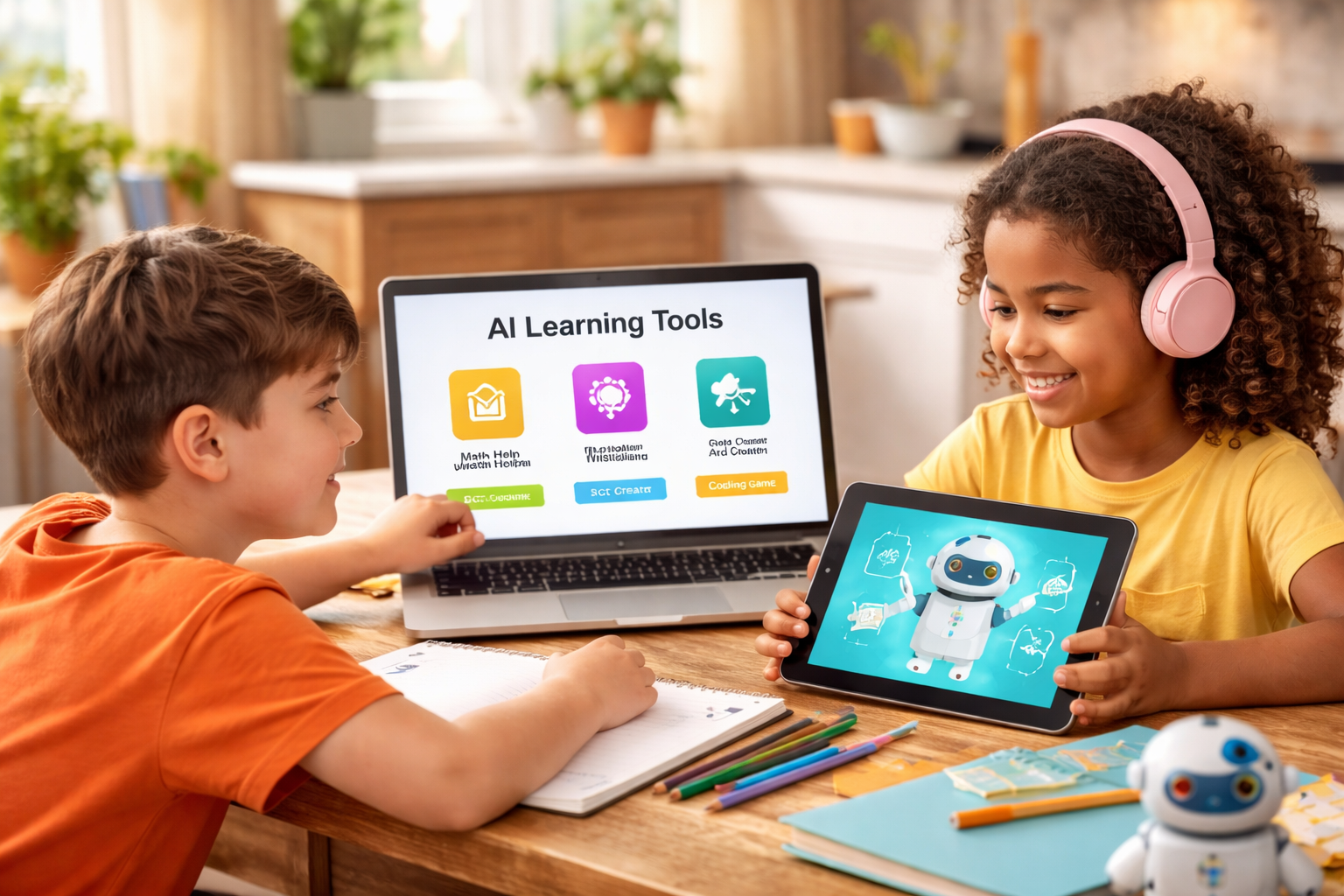
Artificial intelligence is becoming part of everyday learning — from homework help to creative projects. While AI can be a powerful educational tool for kids, parents often ask an important question: Which AI tools are actually safe and useful for children?
This guide highlights some of the best AI tools for kids learning at home, along with tips for using them responsibly.
1. ChatGPT (With Parental Guidance)
ChatGPT can help kids:
- Explain difficult concepts in simple language
- Practice writing and brainstorming ideas
- Ask follow-up questions without pressure
However, it works best when parents:
- Supervise usage
- Set clear boundaries
- Encourage kids to verify answers
➡️ Related reading: Is ChatGPT Safe for Kids? A Parent-Friendly Guide
2. AI-Powered Math & Homework Helpers
Many AI learning tools focus specifically on academics such as:
- Math problem explanations
- Step-by-step solutions
- Practice questions with feedback
These tools are helpful for understanding how to solve problems — not just getting answers.
Parent tip: Encourage kids to explain solutions in their own words to reinforce learning.
3. Reading & Writing Assistants for Kids
AI writing tools can:
- Help kids organize thoughts
- Improve grammar and sentence structure
- Support reluctant writers
When used correctly, they build confidence — but they should never replace original thinking.
➡️ Learn more: How Kids Can Learn Smarter With AI
4. Creative AI Tools (Art, Music, Coding)
Creative AI tools allow kids to:
- Generate art ideas
- Explore basic coding concepts
- Create stories, animations, or music
These tools are excellent for creativity and exploration, especially when paired with offline activities.
5. AI Tools With Built-In Safety Features
Some AI platforms are designed specifically for children and include:
- Content filters
- Age-appropriate responses
- Limited data collection
Parents should always review:
- Privacy policies
- Age recommendations
- Account settings
➡️ Helpful guide: AI Rules Parents Should Set for Kids at Home
How Parents Can Choose the Right AI Tools
Before introducing any AI tool, parents should ask:
- Is it age-appropriate?
- Does it encourage learning or shortcut thinking?
- Are privacy and safety settings available?
- Can usage be supervised?
The best AI tools support learning — they don’t replace curiosity, creativity, or parental involvement.
AI Tools That Support Learning at Home
Many families use AI-powered tools to support learning outside the classroom, especially for homework help, concept revision, and independent study.
When choosing AI tools for home learning, parents often look for:
- Clear explanations rather than automatic answers
- Tools that adapt to a child’s pace
- Parental visibility into how the tool is being used
- Flexibility to support different subjects and learning styles
Some tools are designed for short practice sessions, while others support longer study routines. The right choice depends on how AI fits into your family’s daily learning habits.
Parent perspective:
AI works best at home when it complements school learning and encourages kids to think — not when it replaces effort or responsibility.
(Parent-approved home learning tools will be reviewed and added here in future updates.)
Final Thoughts
AI can be an incredible learning companion when used responsibly. By choosing the right tools and setting clear expectations, parents can help children benefit from AI without compromising safety or critical thinking.
Used wisely, AI becomes a guide — not a crutch.
Disclaimer:
This article is for informational purposes only and does not replace professional educational or parenting advice.