Introduction
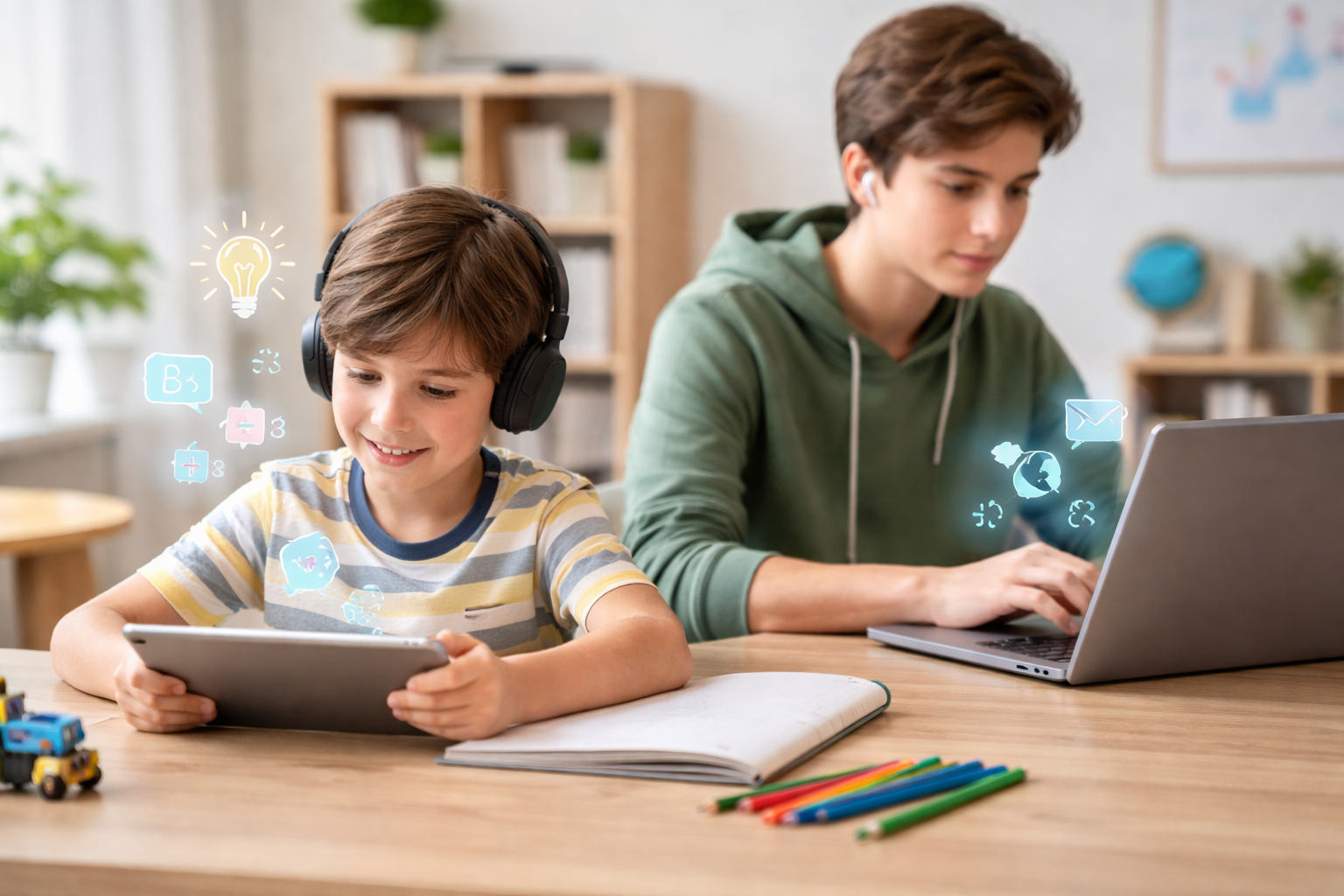
Artificial intelligence is quickly becoming part of everyday learning for children. From explaining homework problems to practicing reading and math, AI-powered tools can support kids at different stages of education.
But not all AI tools are suitable for every age. Choosing the right tool depends on how old your child is, what they’re learning, and how much guidance they need.
This guide breaks down the best AI learning tools for kids by age group, helping parents make informed and responsible choices.
AI Learning Tools for Ages 5–7 (Early Learners)
At this stage, children benefit most from guided, interactive learning. AI should support basic skills like reading, numbers, and curiosity—not replace human teaching.
Best Uses of AI at This Age
- Learning letters and sounds
- Basic math practice
- Asking simple “why” questions
Parent Tips
- Always supervise usage
- Keep sessions short (10–20 minutes)
- Focus on exploration, not accuracy
AI Learning Tools for Ages 8–12 (Elementary & Middle School)
Children in this age group can use AI to understand concepts, not just memorize answers. AI works best as a helper—similar to a study buddy.
Best Uses of AI at This Age
- Explaining math and science topics
- Practicing writing and reading comprehension
- Exploring new subjects safely
Parent Tips
- Encourage kids to ask how and why, not just copy answers
- Review responses together
- Set clear rules on when AI can be used for homework
AI Learning Tools for Ages 13–17 (Teens)
Teenagers can use AI more independently, especially for research, writing support, and exam prep. However, critical thinking and academic honesty are essential.
Best Uses of AI at This Age
- Research assistance
- Writing outlines and editing help
- Studying for exams
Parent Tips
- Discuss plagiarism and ethical use
- Encourage fact-checking
- Treat AI as a supplement, not a shortcut
What Parents Should Look for in AI Learning Tools
Before letting kids use any AI-powered tool, parents should consider:
- Age-appropriate content filters
- No requirement to share personal information
- Clear educational purpose
- Parental controls or supervision options
AI works best when combined with guidance, discussion, and curiosity—not isolation.
How This Connects to AI Safety for Kids
Understanding learning tools also means understanding safety. If you’re new to AI, it’s important to know how these tools handle age limits, privacy, and responsible use.
You may find this helpful:
Together, these guides help parents create a balanced and safe approach to AI learning at home.
Choosing the Right AI Learning Tools by Age
As children grow, their learning needs — and how they interact with AI — change significantly. Some parents choose to explore different AI learning tools depending on their child’s age and level of independence.
When comparing AI learning tools by age group, parents often consider:
- Whether the tool explains concepts instead of giving answers
- How much parental supervision or control is available
- If the content adjusts as the child progresses
- Whether the tool supports school learning rather than replacing it
For younger children, simpler tools with strong boundaries work best. Older kids and teens may benefit from tools that support independent thinking, study planning, and deeper explanations.
Helpful note for parents:
One tool rarely fits every age. What works well this year may not be the right fit next year.
(Age-appropriate AI learning tools will be reviewed and added here as part of future updates.)
Final Thoughts
AI learning tools can be powerful when used correctly. The key isn’t finding the most advanced tool—but the right tool for your child’s age and needs.
With supervision, boundaries, and conversation, AI can support curiosity, confidence, and learning—without replacing real education.
Disclaimer
This article is for informational purposes only and does not replace professional educational advice.